
1000W Power Stations
1000W power stations are the sweet spot for most people: big enough to run a laptop, TV, fridge or CPAP machine for hours, yet still light enough to lift into a car boot or campervan. Most hold around 1,000Wh of LiFePO4 battery, charge from a wall socket in about an hour and top up from solar panels.
Below you'll find Jackery, Anker SOLIX and DJI portable power stations side by side, with real figures in our guide underneath. Need more grunt for a kettle or power tools? See our 2000W models, or for lighter kit browse small portable power stations.
What is a 1000W power station?
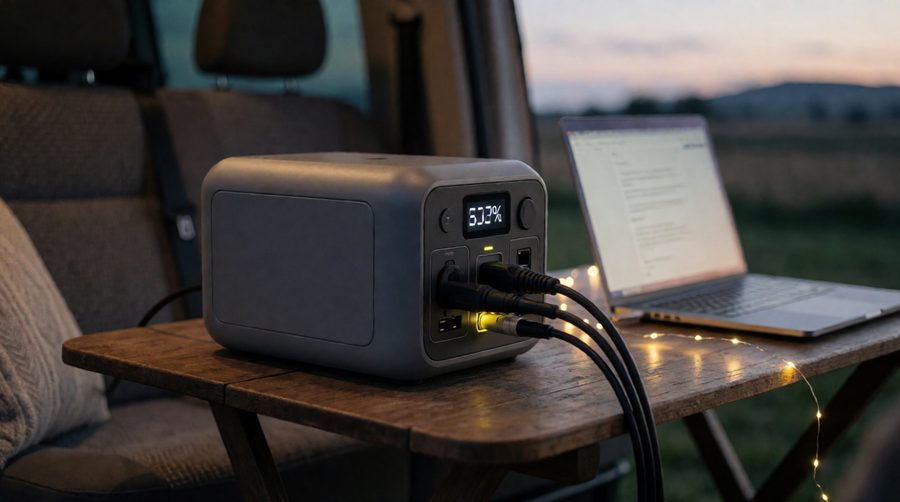
A portable power station is a big rechargeable lithium battery with a built-in inverter - in effect a silent battery generator, so it gives you normal UK three-pin sockets, USB-C, USB-A and a 12V car outlet wherever you are. "1000W" describes the class: power stations in this group either hold roughly 1,000 watt-hours (Wh) of energy, or can deliver at least 1,000 watts of continuous AC output - and the best current models do both with room to spare.
That makes a 1000W power station the most popular size for camping weekends, campervans, garden offices and keeping the essentials going in a power cut. Unlike a petrol generator, a battery power station gives off no fumes and makes almost no noise, so you can use one indoors or in a tent.
Watts vs watt-hours: the two numbers that matter
Shop listings mix up the two figures, but they mean different things:
- Output in watts (W) - how much it can power at once. A 1,500W inverter runs anything up to 1,500W in total; plug in more and it cuts out.
- Surge (peak) watts - a short burst for appliances that need a kick to start, such as fridges and pumps. Most 1000W-class power stations quote 2,000-3,000W surge.
- Capacity in watt-hours (Wh) - how much energy is stored, which decides how long it lasts. 1,024Wh can supply 100W for roughly ten hours, before losses.
A sensible rule: match the output to your biggest appliance, then match the battery capacity to how long you need it to run. Searching for a portable power station 1000W? These two numbers are what to compare.
1000W power stations compared
These are the main 1000W portable power stations in our range, with figures taken from each maker's UK specifications.
| Jackery Explorer 1000 v2 | Anker SOLIX C1000 Gen 2 | DJI Power 1000 V2 | |
|---|---|---|---|
| Capacity | 1,070Wh | 1,024Wh | 1,024Wh |
| Continuous AC output | 1,500W | 2,000W | 2,600W |
| Surge | 3,000W | 3,000W | - |
| Fastest mains recharge | About 1 hour (app fast-charge mode) | About 49 minutes (1,600W input) | About 56 minutes (0-80% in 37 min) |
| Battery chemistry | LiFePO4 | LiFePO4, 4,000 cycles | LFP, 80%+ after 4,000 cycles |
| Weight | About 10.8kg | About 11.3kg | About 13-14kg |
| Stand-out feature | Lightest here | UPS switchover under 10ms | Two 140W USB-C ports, expandable |
Jackery Explorer 1000 v2
The Jackery portable power station is the lightest of the three at around 10.8kg, so it suits anyone who carries it from car to pitch for outdoor trips. Its 1,500W output covers laptops, TVs, fridges and small cooking gadgets, and 1,070Wh is the biggest capacity in this group. It is also sold as the Jackery Solar Generator 1000 v2 with a 100W panel - see more in our Jackery range.
Anker SOLIX C1000 Gen 2
Anker's power station pushes 2,000W continuous from a compact 384 x 208 x 244mm case and refills from the wall in about 49 minutes once HyperFlash charging is switched on in the app. It also accepts up to 600W of solar, and its sub-10ms switchover means it can sit between the wall and a router or PC as an uninterruptible power supply. Anker backs it with a five-year warranty. More models sit in our Anker SOLIX collection.
DJI Power 1000 V2
The DJI has the highest output here at 2,600W, which brings bigger loads like a small microwave or a coffee machine within reach. Two 140W USB-C ports charge laptops and drone batteries quickly, and the system grows to 11,264Wh with add-on batteries. The trade-off is weight - expect around 13-14kg. Compare it with the rest of the DJI line-up.
Other 1000W power stations: Bluetti and EcoFlow
Two more brands make strong 1000W portable power stations worth comparing:
- Bluetti AC70P - 1,000W continuous AC output with 2,000W surge and an 864Wh LiFePO4 battery rated for around 3,000 cycles to 80%. A little smaller on capacity, but a good-value Bluetti power station for camping, outdoor use and emergency backup. See our Bluetti power stations.
- EcoFlow DELTA 3 Plus - 1,024Wh of LFP battery with 1,800W AC output, a full recharge from the wall in about 56 minutes and 4,000 cycles to 80%. Browse the EcoFlow range for this and the bigger DELTA models.
Bluetti and EcoFlow portable power stations both offer apps, USB-C fast charging and solar input, so the choice usually comes down to output, weight and warranty. EcoFlow's DELTA batteries can also be paired with extra battery packs, as can several Bluetti models.
What can a 1000W power station run?
The table shows typical power draw for common UK devices. Check the rating plate on yours, because figures vary by model.
| Device | Typical draw | On a 1000W unit? |
|---|---|---|
| Phone (charging) | 10-25W | Yes - dozens of full charges |
| Laptop | 45-100W | Yes - many hours |
| LED TV (43-55in) | 50-120W | Yes |
| CPAP machine | 30-60W | Yes - several nights |
| Cool box or small fridge | 40-150W when running | Yes - surge covers the compressor start |
| Electric blanket | 60-100W | Yes |
| Microwave (800W rated) | About 1,200W from the socket | On 1,500W+ models, briefly |
| Hair dryer | 1,800-2,200W | Only on 2,000W+ models, on low |
| UK kettle | 2,500-3,000W | Usually no - choose a travel kettle |
Kettles, heaters and ovens are the usual reason people move up to a 3000W power station. For everything else in the list, a 1000W power station is plenty.
How long will it last?
Use this quick sum: capacity (Wh) x 0.85 / appliance watts = hours. The 0.85 allows for inverter losses, which is why you never get the full rated figure from the AC sockets.
- 55in TV at 100W on a 1,024Wh power station: 1,024 x 0.85 / 100 = about 8.7 hours
- CPAP at 40W: about 22 hours, or two to three nights
- Laptop at 60W: about 14 hours
- Small fridge averaging 60W over a day (the compressor cycles on and off): around 14 hours
- Portable solar panel feeding in 100W while you draw 60W: the battery slowly gains charge
Running several devices at once? Add their watts together first. USB-C and 12V outputs skip the inverter, so charging phones and laptops directly from them stretches the battery further.
How to choose the right one
Output first, capacity second
Write down the most power-hungry thing you'll plug in. If it's over 1,500W, rule out the lower-output power stations straight away. Then decide how many hours you need between charges.
LiFePO4 battery and warranty
All three models above use lithium iron phosphate (LiFePO4 or LFP) cells. They last thousands of cycles - roughly ten years of weekly use - and are more thermally stable than the older NMC cells used in early portable power stations. That is why makers now offer five-year warranties on many LiFePO4 models - check the warranty length before you buy.
Pure sine wave and UK sockets
A pure sine wave output gives clean mains-style power, which matters for laptops, CPAP machines and anything with a motor. Check for UK three-pin sockets rather than EU sockets with adapters.
Recharge options
Fast mains charging (about an hour or less on all three here) is ideal before a trip. Solar input lets you top up the battery off-grid at a campsite or on outdoor trips - pair it with one of our portable solar panels. A car charging cable is handy too, though a 12V socket only adds around 100W.
UPS mode and apps
If you want it to protect a router, PC or freezer during a power cut, look for a quick switchover time like the Anker's sub-10ms figure. App control over Wi-Fi or Bluetooth lets you check charge, change charging speed and switch outputs on and off from your phone.
Charging a 1000W power station from solar
Solar panel ratings are measured in ideal lab light, so in the UK expect a portable panel to deliver around half to two-thirds of its rating on a bright day, and far less in winter. A 200W panel might add 600-800Wh across a sunny summer day - enough to refill a 1,024Wh battery in good conditions over a day or so, but not in a few hours. Two solar panels in series, within the input voltage limit, speed it up. A station sold with panels is often called a solar generator; we list bundles in our solar generator range.
Camping, outdoor trips and emergency backup power
For a long weekend of camping under canvas, a 1000W portable power station runs lights, a cool box, phone and laptop charging and a fan without needing a hook-up pitch. Browse our camping power stations for lighter options and models with built-in lights.
At home it is emergency backup power for short power cuts: the router, a lamp, phone chargers and a chest freezer for a few hours, with no generator fuel to store. If the cut lasts longer, call the free 105 power cut line to find out when it will be back. For whole-house cover, larger power stations in our home battery backup section hold several kWh and can expand further.
Safety and storage
- Use and charge your power station on a hard, flat surface with the vents clear - never on a bed or under bedding.
- Store it at around 50-60% charge somewhere cool and dry, and top it up every three months.
- Only use the charger and cables supplied by the maker; the London Fire Brigade advice on lithium batteries explains why.
- Don't run petrol generators indoors as a cheaper alternative - a battery unit is the safe choice for tents and vans.
The full specs for the power stations above are on the DJI Power 1000 V2 spec sheet and Anker SOLIX C1000 Gen 2 product page.
1000W power stations: FAQs
Can a 1000W power station run a kettle?
Usually not. A standard UK kettle draws 2,500-3,000W, which is beyond a 1,500W or 2,000W inverter. A low-wattage travel model (around 1,000W or less) will work on most 1000W power stations.
Will it run a fridge?
Yes. A typical fridge draws under 150W while its compressor runs, and the 3,000W surge rating handles the start-up kick. Expect most of a day from a 1,024Wh power station, depending on the model and how often it's opened.
How long does it take to charge?
From a wall socket, the latest models refill in roughly 49-60 minutes using their fast-charge modes. Solar takes much longer and depends on the weather and panel size.
Is 1000W enough for a campervan?
For lights, a fridge, a fan, laptops and phones, yes. If you want to use a hair dryer, induction hob or a full-size kettle, look at 2,000W or more.
Can I take one on a plane?
No. Airlines limit lithium batteries to 100Wh without approval and 160Wh with it, so a 1,000Wh portable power station has to travel by road or sea.
Do I need a 1000W or 1000Wh model?
Ideally both. Watts decide what it can run; watt-hours decide for how long. A portable power station with 1,500-2,600W output and around 1,000Wh of capacity is the balance most buyers want.