
3000W Portable Power Stations
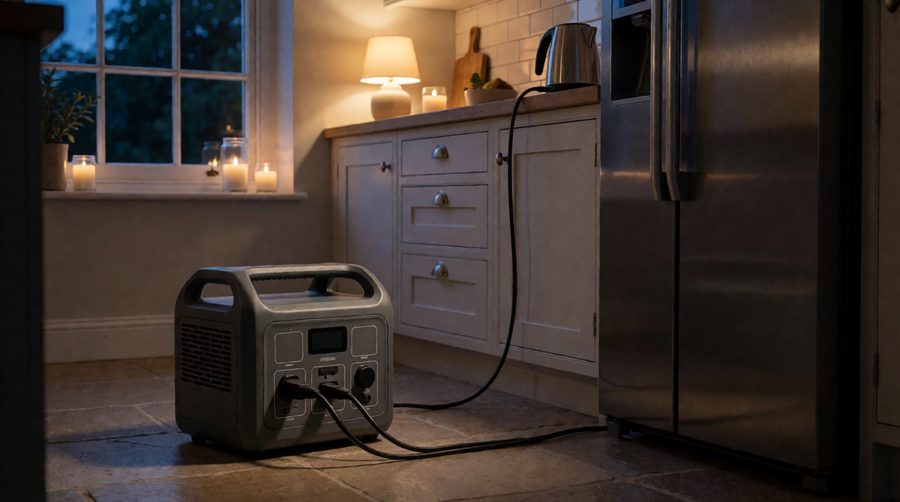
3000W portable power stations are the biggest batteries you can still wheel around: enough output to boil a full-size UK kettle, run a microwave or a mitre saw, and around 3kWh of stored energy to keep a fridge-freezer, router and lights going through a long power cut. They suit home backup, motorhomes and caravans, and trades working away from the mains.
Below are Jackery, Bluetti, EcoFlow and VTOMAN models, with real figures in our guide underneath. Need something lighter? Our 2000W power stations weigh 18-24kg instead of 26-39kg.
What is a 3000W portable power station?
A portable power station is a large lithium battery with a built-in inverter, giving you UK three-pin sockets, USB-C and a 12V car outlet wherever you are - a silent, fume-free alternative to a petrol generator. "3000W" gets used for two different things, and it pays to know which one you are buying:
- 3,000W or more of output - how much the inverter can supply at once. This is what lets it run a kettle, heater or power tools.
- About 3,000Wh (3kWh) of capacity - how much energy is stored, so how long it keeps going.
The Jackery Explorer 3000 v2 and VTOMAN FlashSpeed Pro 3600 give you both. The Bluetti Elite 300 and Elite 400 are 3kWh-plus batteries with 2,400-2,600W inverters, and the EcoFlow DELTA 3 Max Plus is the reverse: 3,000W of output from a 2,048Wh battery. The table shows which is which.
3000W portable power stations compared
Portable power station figures are from each maker's UK listing, UK retailers and independent reviews.
| Capacity | AC output (surge) | Weight | Mains recharge | Expandable | |
|---|---|---|---|---|---|
| Jackery Explorer 3000 v2 | 3,072Wh | 3,600W (7,200W) | About 27kg | Full in about 1.8 hours | No |
| VTOMAN FlashSpeed Pro 3600 | 3,096Wh | 3,600W (6,000W) | About 38kg | Full in about 2 hours | Extra battery available |
| BLUETTI Apex 300 | 2,764.8Wh | 3,840W (7,680W) | About 38kg | - | Yes, to over 50kWh |
| EcoFlow DELTA 3 Max Plus | 2,048Wh | 3,000W (6,000W) | About 22kg | 2,300W input | Yes, to 10kWh |
| BLUETTI Elite 400 | 3,840Wh | 2,600W (5,200W) | About 39kg, on wheels | 0-80% in about 70 min | No |
| BLUETTI Elite 300 | 3,014.4Wh | 2,400W (4,800W) | About 26kg | 2,300W input | No |
| AFERIY P280 | 2,048Wh | 2,800W (5,600W) | About 22kg | 0-80% in about 55 min | Yes, to 10,240Wh |
| Anker SOLIX C2000 Gen 2 | 2,048Wh | 2,400W (4,000W) | - | 0-80% in about 45 min | Yes, with an add-on battery |
Jackery Explorer 3000 v2
The most rounded 3000W portable power station here. It pairs 3,600W of pure sine wave output (7,200W surge) with 3,072Wh of LFP battery at around 27kg - light for a true 3kWh unit. You get three 13A UK sockets, two 100W USB-C ports, two USB-A and a 12V car port. A wall socket refills it in about 1.8 hours, and Jackery rates the cells for 4,000 cycles. Full details are on the Jackery UK product page, and the rest of the range is in our Jackery collection.
VTOMAN FlashSpeed Pro 3600
This portable power station matches the Jackery's 3,600W output (6,000W peak) and adds a touch more capacity at 3,096Wh, usually for less money. The catch is weight: about 38kg, so it suits a garage, van or caravan rather than carrying to a pitch. It charges at 1,800W from the mains, full in about two hours, and accepts up to 800W of solar. There are four AC sockets, two 100W USB-C and four USB-A. Compare it with other VTOMAN models.
BLUETTI Apex 300
The most powerful portable power station here: 3,840W continuous and 7,680W peak, from 2,764.8Wh. It is built as the heart of a home system rather than a grab-and-go battery - at about 38kg, with expansion batteries taking it past 50kWh. If you want to grow into whole-house backup, start with this. See the full Bluetti line-up.
EcoFlow DELTA 3 Max Plus
The lightest portable power station with a full 3,000W inverter, at about 22kg. Its 2,048Wh battery won't last as long as the 3kWh units, but add-on batteries take it to 10kWh, it charges at up to 2,300W from the mains, and the UPS switches over in under 10ms. Browse EcoFlow power stations.
BLUETTI Elite 300 and Elite 400
These two portable power stations are about capacity rather than raw output. The Elite 300 squeezes 3,014.4Wh into a box of about 26kg; the Elite 400 holds 3,840Wh on wheels with a telescopic handle, at about 39kg. Their 2,400W and 2,600W inverters run a microwave, hair dryer or coffee machine happily, but not a 3kW kettle. Bluetti rates the Elite 300 for 6,000+ cycles. For long power cuts with ordinary appliances, they give the most hours per pound.
Power station watts vs watt-hours
- Continuous output (W) - the most it runs at once. Add up everything you'll plug in together and stay under it.
- Surge (W) - a brief burst for motors and compressors. A fridge or saw can pull several times its running watts for a split second.
- Capacity (Wh) - how long it lasts. A 3,072Wh battery supplies 200W for roughly 13 hours after losses.
Output decides what it can run; capacity decides for how long. A 3,000W inverter on 2kWh boils a kettle as fast as one on 3kWh - it just runs out sooner.
What can a 3000W power station run?
Typical draws for common UK appliances - check the rating plate on yours.
| Appliance | Typical draw | On a 3000W power station? |
|---|---|---|
| UK kettle | 2,500-3,000W | Yes on 3,000W+ models - about 15 boils from 3kWh |
| Fridge-freezer | 100-200W when the compressor runs | Yes - well over a day from 3kWh |
| Microwave (800W rated) | About 1,200W from the socket | Yes - about two hours of cooking in total |
| Electric heater on 2kW | 2,000W | Yes, for about 1.3 hours |
| Induction hob, one zone | 1,500-2,000W | Yes |
| Mitre saw or table saw | 1,500-2,000W, high start-up surge | Yes - the surge rating covers start-up |
| Wi-Fi router and modem | 10-20W | Yes - about a week |
| CPAP machine | 30-60W | Yes - over a week of nights |
Anything from a normal 13A socket is fair game on the 3,600W portable power stations, and you can run two mid-sized appliances at once. If you only need the run time and never the kettle, the 2000W power stations are cheaper and lighter; if you need days of backup, look at home battery backup systems.
How long will a 3000W power station last?
To work out how long a portable power station lasts, use this sum: capacity (Wh) x 0.85 / appliance watts = hours. The 0.85 allows for inverter losses.
- Fridge-freezer averaging 80W on a 3,072Wh unit: 3,072 x 0.85 / 80 = about 33 hours
- 55in TV at 100W: about 26 hours
- 2kW heater: about 80 minutes
- 3kW kettle: around 50 minutes of boiling - roughly 15-17 full kettles
For a 24-hour power cut, a fridge-freezer (about 2,000Wh), router (400Wh), lights (250Wh) and phones (100Wh) come to about 2,750Wh - inside a 3kWh battery but well beyond a 2kWh one. Charge phones and laptops from USB-C, which skips the inverter and stretches the battery further.
How to choose a 3000W portable power station
Need a kettle? Get 3,000W or more of output
Only the Jackery, VTOMAN, EcoFlow and Bluetti Apex boil a full-size kettle at normal speed. For everything else, 2,400-2,800W is enough.
Long power cuts? Prioritise capacity
The Elite 400's 3,840Wh beats every other portable power station here for hours. A 3kWh battery covers a full day of essentials.
Weight and wheels
These portable power stations weigh 22-39kg. Over about 30kg, look for wheels and a telescopic handle, as on the Elite 400. For camping, our camping power stations are far easier to carry.
Expandable battery and UPS
The Apex 300, DELTA 3 Max Plus and AFERIY P280 take extra batteries, so you can start at 2-3kWh and add more. Most of these portable power stations have a UPS mode that switches over in around 10ms, fast enough to keep a PC or router running when the power drops.
LiFePO4 cells and warranty
Every portable power station here uses LiFePO4 (LFP) cells rated for thousands of cycles - 4,000 on the Jackery, 6,000+ on the Elite 300 - which is roughly ten years of regular use. Check the warranty length and the app's controls before you buy.
Charging a portable power station from solar
Solar panel ratings are measured in ideal light. In the UK, expect around half to two-thirds of the rating on a bright summer day and far less in winter. Two 200W panels add roughly 1,000-1,500Wh over a sunny day, so refilling 3kWh takes two days unless you add more panels up to the station's solar input limit (800W on the VTOMAN, 1,200W on the Elite 300 and AFERIY). Pair one with our portable solar panels, or buy them together as a solar generator bundle.
Home backup, caravans and off-grid work
A 3kWh portable power station is a sensible size for home backup: it keeps the fridge-freezer cold and the router on for a whole day, with no fuel to store. A portable power station isn't wired into your house - you plug appliances straight in. Connecting one to home wiring needs a changeover switch fitted by a qualified electrician. If a cut drags on, ring the free 105 power cut line for updates from your network operator.
In a motorhome or caravan, a 3000W portable power station runs the kettle, microwave and hair dryer that smaller units can't, and a 12V car port and solar input keep it topped up on the move. Trades use the bigger portable power stations for saws, compressors and SDS drills where a petrol generator would be too noisy. Prefer a lighter portable power station for the van? See Anker SOLIX and DJI - the DJI Power 2000 gives 3,000W of output at about 22kg.
Safety and storage
- Use and charge the portable power station on a hard, flat surface with the vents clear.
- Store your portable power station at about 50-60% charge somewhere cool and dry, and top it up every three months.
- Use only the maker's chargers and cables - the London Fire Brigade lithium battery advice explains why.
- Never run a petrol generator indoors or in a tent; a battery power station is the safe choice.
3000W portable power stations: FAQs
Can a 3000W portable power station run a kettle?
Yes, if the continuous output is 3,000W or more and your kettle is rated at or below it. A 3kW kettle uses about 0.15kWh per boil, so a 3kWh battery gives around 15 boils. The 2,400W Elite 300 won't run a full-size kettle.
Is 3000W the same as 3000Wh?
No. 3000W is how much it powers at once; 3000Wh is how much it stores. The Jackery Explorer 3000 v2 and VTOMAN FlashSpeed Pro 3600 have both.
Should I choose 2kWh or 3kWh?
Choose 3kWh for a full day of home backup or a weekend off-grid without solar. 2kWh is enough for evening power cuts and saves 5-15kg.
Will a portable power station run my whole house?
No - it runs the appliances you plug into it. For more, look at expandable systems such as the Bluetti Apex 300.
How long does a mains recharge take?
About 1.8-2 hours to full on the Jackery and VTOMAN, and under an hour to 80% on fast-charging models such as the Anker SOLIX C2000 Gen 2.
Can I take one on a plane?
No. Airlines limit lithium batteries to 160Wh even with approval - see the Civil Aviation Authority rules.