
ALLPOWERS Power Stations
ALLPOWERS power stations are some of the cheapest LiFePO4 batteries per watt-hour you can buy in the UK, from the 3.6kg VOLIX P300 for phones and camping lights up to the 3kWh-plus R3500 and R4000 for home backup. These portable power stations suit campers, campervan owners and anyone who wants a quiet, fume-free standby for power cuts on a tight budget.
Below are the ALLPOWERS models we track, with a model-by-model comparison in the guide underneath. Want something lighter to carry? See our small portable power stations or the wider range of camping power stations.
What is an ALLPOWERS power station?
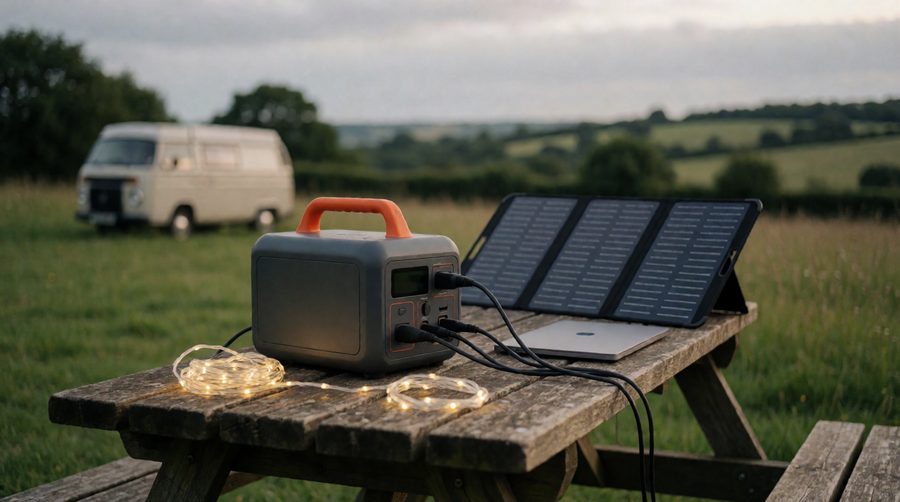
ALLPOWERS is a Chinese maker of portable power stations, solar panels and power banks that sells in the UK through Amazon and its own UK store, uk.iallpowers.com. Each ALLPOWERS portable power station is a rechargeable battery with a pure sine wave inverter, so you get UK three-pin sockets, USB-C, USB-A and a 12V car outlet wherever you are. You charge it from the mains, a car socket or a solar panel, then run laptops, lights, fridges and small appliances from it - silently, with no fuel and no fumes.
The current line-up falls into three ranges:
- R series - the main range: R600, R1500 LITE, R2500, R3500 and R4000. All use LiFePO4 cells rated for 3,500+ cycles to 80% capacity, and the bigger ones double as a home backup power station with a UPS mode.
- VOLIX P series - the P300 and P1800, newer LiFePO4 models aimed at camping and touring.
- S series - older models such as the S300 Plus and S2000 Pro. The S2000 Pro uses NCM (ternary lithium) cells rated for about 2,500 cycles, fewer than the R series.
ALLPOWERS power stations compared
Figures come from ALLPOWERS' UK and EU listings, UK retailers and independent reviews. Where listings disagree we give the range.
| Model | Capacity | AC output (peak) | Weight | Battery | Best for |
|---|---|---|---|---|---|
| VOLIX P300 | 256Wh | 300W (600W) | 3.57kg | LiFePO4 | Phones, lights, fans, CPAP for a night |
| R600 | 299Wh | 600W (1,200W) | About 5.4-5.8kg | LiFePO4 | Weekend camping, laptops, a cool box |
| R1500 LITE | 1,056Wh | 1,600W (3,200W) | 15kg | LiFePO4, 3,500+ cycles | Campervans, small appliances, evening power cuts |
| VOLIX P1800 | 1,024Wh | 1,800W | Check the listing | LiFePO4 | Campervans; expandable battery |
| S2000 Pro | 1,451Wh (sold as 1,500Wh) | 2,400W (4,000W) | 14.5kg | NCM, about 2,500 cycles | Lighter 1.5kWh option, older design |
| R2500 | 2,016Wh | 2,500W (4,000W) | 29kg | LiFePO4, 3,500+ cycles | Home backup, motorhomes, kettles up to 2.5kW |
| R3500 | 3,168Wh | 3,500W (6,000W) | Heavy - on wheels | LiFePO4; adds up to 3 B3000 packs | Whole-day home backup, app control |
| R4000 | 3,456Wh | 3,600-4,000W (6,000W) | Heavy - on wheels | LiFePO4 | Largest single unit for home backup power |
For scale, ALLPOWERS' UK store listed the R1500 LITE at an RRP of £649 and the R2500 at £999 - roughly 50p per watt-hour, which is why the brand turns up in so many budget comparisons. Amazon prices move often, so check the current price on each listing.
Which ALLPOWERS model suits you?
Camping weekends: ALLPOWERS R600 or VOLIX P300
The ALLPOWERS R600 is the best seller for good reason. Its 299Wh runs a 50W 12V cool box for around five hours, charges a laptop four or five times and keeps phones, lights and a fan going for a weekend. It charges from flat to full in about an hour on the mains with its 400W AC input, and nine outputs include two 100W USB-C ports and a 15W wireless pad. The VOLIX P300 is lighter at 3.57kg but its 300W inverter is for small devices only. For other small units, compare our 1000W power stations and compact power stations from other brands.
Campervans, caravans and off-grid trips: ALLPOWERS R1500 LITE or P1800
With about 1kWh, either one runs a compressor fridge for a day or two, plus lights, a laptop and short bursts from a 1,200W travel kettle or hair dryer. The ALLPOWERS R1500 LITE has four AC sockets, solar charging up to its XT60 limit and a UPS that switches over in 15ms or less at a quiet 35dB. At 15kg it is still a one-person lift.
Home backup power: ALLPOWERS R2500, R3500 or R4000
For a home backup power station you want 2kWh or more. The ALLPOWERS R2500 runs most 13A appliances, and its 2,016Wh keeps a fridge-freezer, router and lights going for most of a day. The R3500 adds app control, 1,300W of solar input and a full mains charge in about 1.5 hours, and you can add one to three B3000 battery packs. Compare these with our 2000W power stations, 3000W power stations and home battery backup picks before you decide.
What will an ALLPOWERS portable power station run?
| Appliance | Typical draw | Smallest model that runs it |
|---|---|---|
| Phone, tablet, camera batteries | 5-30W | VOLIX P300 |
| Laptop | 45-100W | VOLIX P300 (USB-C) or R600 |
| CPAP machine | 30-60W | R600 - about 4-8 hours |
| 12V compressor cool box | 40-60W while running | R600 |
| TV | 60-120W | R600 |
| Fridge-freezer | Averages 60-100W, start-up surge | R1500 LITE |
| Travel kettle or hair dryer | 1,000-1,500W | R1500 LITE |
| Microwave | 1,000-1,500W input | R1500 LITE |
| Full-size 3kW kettle | 2,500-3,000W | R3500 or R4000 |
A kettle on the R2500 needs to be rated at 2.5kW or less. On the R600, the 1,200W peak only covers start-up surges - it won't run anything over 600W for more than a moment.
How to choose an ALLPOWERS portable power station in 4 steps
- List what you will plug in and add up the watts. The biggest single appliance sets the output you need - 600W for a laptop and cool box, 1,600W+ for a travel kettle, 2,500W+ for a full-size kettle.
- Work out the hours with the sum below. That gives the capacity: about 300Wh for a weekend away, 1kWh for a week in a campervan with solar, 2-3kWh of backup power for a day-long power cut.
- Decide how you will recharge - mains only, a 12V car socket while driving, or solar. If off-grid solar charging matters, check the solar input limit.
- Check the weight. Under 6kg you can carry it to a tent; 15kg is a two-handed lift; 29kg and up wants wheels.
How long will it last?
ALLPOWERS gives this sum: capacity (Wh) x 86% / appliance watts = hours. The 86% allows for inverter losses. Some worked examples:
- R600 with a 60W TV: 299 x 0.86 / 60 = about 4 hours
- R1500 LITE with a 50W cool box: 1,056 x 0.86 / 50 = about 18 hours
- R2500 with a fridge-freezer averaging 80W: 2,016 x 0.86 / 80 = about 21 hours
- R3500 with a 400W load: 3,168 x 0.86 / 400 = about 6.8 hours (ALLPOWERS' own example)
Charge phones and laptops from the USB-C ports where you can - it skips the inverter, so the battery lasts longer.
Solar charging and solar panels
Every model has an XT60 solar input, and ALLPOWERS sells a folding solar panel to match each size, such as the SE200 200W and SP037 400W. The limits differ a lot: about 110W on the VOLIX P300, around 220W on the R600, 1,000W on the R2500 and 1,300W on the R3500. Solar panel ratings are measured in perfect light, so in the UK expect about half to two-thirds of the rating on a bright summer day and much less in winter. A 200W solar panel refills an R600 in a sunny afternoon but needs several days to fill an R2500. See our portable solar panels, or buy a station and solar panel together as a ready-made solar generator kit. ALLPOWERS sells most models as solar generator bundles with a 100W, 200W or 400W panel, which works out cheaper than buying the two separately.
LiFePO4 or NCM: why it matters
Lithium iron phosphate (LFP) cells are heavier but last much longer and are more stable when hot. ALLPOWERS rates the R series at 3,500+ cycles to 80% capacity - near enough ten years of weekly use - and says the R4000 still holds over 50% after 6,500 cycles. The S2000 Pro's NCM cells are lighter but rated for fewer. Unless weight matters above all, pick an R-series or VOLIX model.
Warranty and after-sales: read this first
This is the weak spot. ALLPOWERS' UK store has a small Trustpilot profile (around 31 reviews when we checked) and most are negative: owners of the R600, R2500 and R4000 describe units failing within a year, warranty claims that took weeks of emails and slow replies from overseas support. Plenty of owners have no problems, but you should plan for the worst:
- Buy through Amazon UK, where returns in the first 30 days go through Amazon rather than the maker.
- Pay by credit card for anything over £100 - Section 75 gives you a second route if a claim stalls.
- Keep the order number and photos of the unit and its serial number.
- Know your rights: goods must be of satisfactory quality and last a reasonable time - see gov.uk consumer protection rights.
If you'd pay more for bigger UK support teams, compare EcoFlow, Jackery, Bluetti and Anker SOLIX. For a similar price-per-watt-hour approach, see VTOMAN; for the lightest high-output units, DJI.
Safety and storage
- Use and charge it on a hard, flat surface with the vents clear - not on a bed or carpet.
- Store it at about 50-60% charge somewhere cool and dry, and top it up every three months.
- Use only the supplied chargers and cables - the London Fire Brigade lithium battery advice explains why.
- In a long power cut, ring 105 for updates from your network operator.
ALLPOWERS power station FAQs
Is ALLPOWERS a good brand?
The hardware is good value: LiFePO4 cells, pure sine wave output and fast charging at lower prices than most rivals. The risk is after-sales support, which UK reviews rate poorly, so buy where returns are easy.
Can the ALLPOWERS R600 run a kettle?
No. Its 600W output is far below a 2-3kW kettle. You need the R3500 or R4000 for a full-size kettle, or the R2500 for one rated at 2.5kW or less.
How long does ALLPOWERS R600 charging take?
About an hour from flat on the mains. On solar it depends on the panel and the weather - a 200W panel in good sun takes around two to three hours.
Can I use one as a UPS?
Yes. The R600, R1500 LITE and R3500 switch to battery within about 10-15ms when the mains fails, fast enough for most routers, PCs and CPAP machines. Leave it plugged in and plug your device into it.
Which is the biggest ALLPOWERS model?
The R4000 at 3,456Wh. The R3500 holds 3,168Wh on its own but can add up to three B3000 packs, making it the largest system overall.
Can I take one on a plane?
No. Even the P300 is over the 160Wh limit for lithium batteries - see the Civil Aviation Authority rules.