
2000W Power Stations
2000W power stations are where a portable battery stops being a camping gadget and starts covering real household jobs: the fridge-freezer in a power cut, a microwave in the campervan, or power tools on a site with no mains. Most models in this class hold around 2,000Wh of long-life LiFePO4 battery, deliver 2,000-3,000W from UK three-pin sockets and refill from the wall in about an hour.
Below are DJI, Bluetti, Anker SOLIX and VTOMAN models side by side, with real figures in our guide underneath. Want something lighter? See our 1000W power stations, or step up to 3000W models for full-size kettles and heaters.
What is a 2000W power station?
A portable power station is a large rechargeable lithium battery with a built-in inverter, so it gives you ordinary UK sockets, USB-C, USB-A and a 12V car outlet wherever you are - a silent, fume-free battery generator. "2000W" is used for two different things, and good models now do both:
- 2,000W of output - the inverter can supply 2,000 watts at once, enough for most kitchen appliances one at a time.
- About 2,000Wh of capacity - roughly 2kWh of stored energy, enough to keep a fridge, router and lights going through a long evening without mains.
Shoppers searching for a 2000W portable power station or a 2kW power station usually want that pairing. Some cheaper units reach 2,000W of output with only about 1,000Wh inside, which is fine for short bursts but runs out quickly under heavy loads - the comparison below shows which is which.
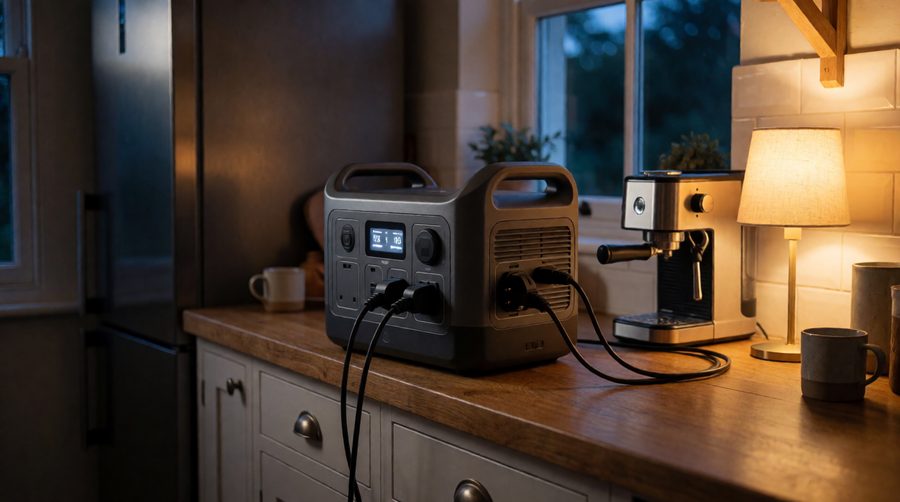
2000W power stations compared
These are the main models in our 2000W range, with figures from each maker's UK listing or specifications.
| Capacity | AC output | Weight | Fast recharge | Battery life | |
|---|---|---|---|---|---|
| DJI Power 2000 | 2,048Wh | 3,000W | About 22kg | 0-80% in about 45-55 min | 80%+ after 4,000 cycles |
| DJI Power Auro 2000 Elite | 2,016Wh | 2,000W | About 19kg | 0-80% in about 60 min | LiFePO4 |
| Bluetti Elite 200 V2 | 2,073.6Wh | 2,600W (3,900W power lifting) | About 24.2kg | 0-80% in about 50 min | 6,000+ cycles |
| Jackery Explorer 2000 v2 | 2,042Wh | 2,200W (4,400W surge) | About 18kg | - | LiFePO4 |
| VTOMAN Jump 2200 | About 1.4-1.5kWh, expandable | 2,200W (4,400W peak) | About 17.5kg | - | LiFePO4 |
| Anker SOLIX C1000 Gen 2 | 1,024Wh | 2,000W (3,000W peak) | About 11.3kg | Full in about 49 min | 4,000 cycles |
DJI Power 2000
The DJI Power 2000 has the most output here at 3,000W, which brings a full-size UK kettle or a mitre saw within reach. It packs 2,048Wh of LFP battery, four AC sockets, two 140W and two 65W USB-C ports, and DJI says it runs as quietly as about 30dB while recharging - useful in a bedroom or tent. At around 22kg it is a two-handed lift. Compare it with the rest of the DJI range.
DJI Power Auro 2000 Elite
New for autumn 2026, this Auro model squeezes 2,016Wh into a body the size of DJI's 1kWh models and weighs about 19kg. Its party trick is a built-in 600W car charger and MPPT solar controller, so it refills from a van's alternator or panels without extra boxes, and a 140W retractable USB-C cable handles laptops. Output is 2,000W - fine for most appliances, but motor loads with a big start-up spike may struggle.
Bluetti Elite 200 V2
Bluetti's 2kWh model gives 2,073.6Wh and 2,600W of continuous output, plus a "power lifting" mode that runs resistive loads such as kettles and heaters up to 3,900W at reduced voltage. It accepts up to 1,000W of solar, and Bluetti rates the cells for 6,000+ cycles - about 17 years of regular use. See the full Bluetti line-up.
Anker SOLIX C1000 Gen 2 and VTOMAN Jump 2200
These two give you 2,000W-plus output in a lighter, cheaper package. The Anker SOLIX power station delivers 2,000W (3,000W peak) from 1,024Wh and recharges in about 49 minutes at 1,600W, at only around 11.3kg. The VTOMAN Jump 2200 offers 2,200W continuous and 4,400W peak, with two 100W USB-C ports and an extra battery that roughly doubles its capacity. Both run a hair dryer or coffee machine happily, just not for as long. Browse Anker SOLIX power stations and VTOMAN models.
Watts vs watt-hours: what 2000W really buys you
Three figures decide whether a 2000W power station suits you:
- Continuous output (W) - the most it can run at once. Add up everything you'll plug in at the same time and keep under it.
- Surge or peak (W) - a brief burst for appliances with motors or compressors. A fridge can pull three to five times its running watts for a split second as it starts.
- Capacity (Wh) - how much energy is stored, so how long it lasts. 2,048Wh can supply 200W for roughly eight and a half hours after losses.
Output decides what it can run; capacity decides for how long. A 2,000W inverter on a 1kWh battery runs a coffee machine for a while; a 2kWh battery lets you keep going all weekend.
What can a 2000W power station run?
Typical figures for common UK appliances - check the rating plate on yours, as models vary.
| Appliance | Typical draw | On a 2000W power station? |
|---|---|---|
| Fridge-freezer | 100-200W when the compressor runs | Yes - most of a day or longer from 2kWh |
| Chest freezer | 60-100W average | Yes - around a day |
| Wi-Fi router and modem | 10-20W | Yes - days |
| Laptop or TV | 50-120W | Yes - many hours |
| CPAP machine | 30-60W (more with heated humidifier) | Yes - several nights |
| Microwave (800W rated) | About 1,200W from the socket | Yes |
| Coffee machine | 1,000-1,500W | Yes |
| Hair dryer | 1,800-2,200W | Yes on 2,200W+ models |
| UK kettle | 2,500-3,000W | Only on 3,000W units or with power lifting |
| Electric heater on high | 2,000-3,000W | Briefly - it drains 2kWh in about an hour |
The pattern: anything from a normal 13A socket is fair game one at a time on the higher-output models, and you can stack small loads all day. What 2kWh can't do is run heaters, ovens or tumble dryers for long. If those matter, look at our 3000W power stations or the expandable systems in home battery backup.
How long will a 2000W power station last?
Use this quick sum: capacity (Wh) x 0.85 / appliance watts = hours. The 0.85 allows for inverter losses, so you never get the full figure from the AC sockets.
- Fridge-freezer averaging 80W over a day on a 2,048Wh station: 2,048 x 0.85 / 80 = about 22 hours
- Router and modem at 20W: over three days
- 55in TV at 100W: about 17 hours
- CPAP at 40W: around 43 hours - four or five nights
- Microwave at 1,200W: about 85 minutes of cooking in total
For a 12-hour evening power cut, a fridge-freezer (about 1,000Wh), router (240Wh), lights (150Wh) and phones (100Wh) come to roughly 1,500Wh - comfortably inside a 2kWh battery, but beyond a 1,024Wh unit. USB-C and 12V outputs skip the inverter, so charging phones and laptops from them stretches the battery further. Keep the station on charge from the grid when you can, and it is full the moment you need it.
How to choose the right one
Match output to your biggest appliance
Write down the most power-hungry thing you'll plug in. If you want a full-size kettle, only a 3,000W inverter (or Bluetti's power lifting) will boil it. For coffee machines, hair dryers and power tools, 2,000-2,600W is enough.
Then pick capacity for run time
For home backup through an evening power cut, aim for 2kWh. For weekend camping with a cool box and lights, 1kWh with 2,000W output is lighter and cheaper.
Weight and portability
True 2kWh models weigh 17-24kg - portable, but not something you carry far. If it'll live in the boot or garage, weight matters less; for festivals and walking to a pitch, the lighter Anker SOLIX is the easier carry.
Expandable battery
Several of these power stations are expandable with add-on packs - the VTOMAN to around double, DJI and Bluetti systems further - so you can start at 2kWh and add more later.
LiFePO4 cells, warranty and app
Every model here uses LiFePO4 (LFP) cells, which last thousands of cycles and are more stable than older NMC batteries. Check the warranty length - five years is now common - and whether the app lets you set charging speed and switch outputs remotely.
Charging from solar panels
Portable solar panel ratings are measured in ideal light, so in the UK expect around half to two-thirds of the rating on a bright summer day and much less in winter. Two 200W panels might add 1,000-1,500Wh of charging over a sunny day, which can refill a 2,048Wh battery in good conditions but not in a few hours. Higher solar input (the Bluetti takes up to 1,000W) shortens that if you have the panels. Check the voltage limit before wiring panels in series. Pair your power station with our portable solar panels, or buy them together as a solar generator bundle.
2000W power stations for home backup
A 2kWh battery is the smallest size we'd suggest for home backup when the grid goes down. It keeps the fridge-freezer cold, the router on for working from home and a few lamps lit through an evening, with no petrol to store and no fumes. Some models switch over fast enough to act as an uninterruptible power supply for a PC or router - check the switchover time. If a cut drags on, call the free 105 power cut line for updates from your network operator.
A portable power station isn't wired into your house: you plug appliances straight into it. Connecting one to home wiring needs a proper changeover switch fitted by a qualified electrician.
Camping, campervans and off-grid work
For campervans and longer off-grid trips, a 2000W power station runs an induction hob on low, a coffee machine or a hair dryer that a 1kW unit can't. DIYers and trades use them for saws and drills where there is no mains, without a generator's noise. For weekend camping where weight matters more, our camping power stations and small portable power stations are easier to carry. Comparing brands? The Jackery Explorer 2000 v2 is the lightest true 2kWh model at about 18kg, and EcoFlow's DELTA range covers the same class. See Jackery and EcoFlow too - both also sell solar generator bundles with panels.
Safety and storage
- Use and charge it on a hard, flat surface with the vents clear, away from bedding and soft furnishings.
- Store at about 50-60% charge somewhere cool and dry, and top it up every three months.
- Use only the maker's chargers and cables - the London Fire Brigade lithium battery advice explains why.
- Don't use a petrol generator indoors as a cheaper alternative; a battery unit is the safe choice for homes, tents and vans.
Full figures are on the DJI Power 2000 spec sheet.
2000W power stations: FAQs
Can a 2000W power station run a kettle?
A standard UK one draws 2,500-3,000W, so you need a 3,000W model such as the DJI Power 2000, or Bluetti's power lifting mode, which heats more slowly. A low-wattage travel model works on any 2000W power station.
Will it run a fridge-freezer?
Yes. A fridge-freezer averages well under 150W and the surge rating covers the compressor start. Expect most of a day from a 2kWh battery, more if you keep the door shut.
Is 2000W the same as 2000Wh?
No. 2000W is how much it can power at once; 2000Wh is how much energy it stores. The best 2000W power stations offer both, but some pair 2,000W output with a 1kWh battery.
How many solar panels do I need?
Two 200W panels add roughly 1,000-1,500Wh on a sunny UK summer day, so a 2kWh battery takes one to two days. Winter takes much longer - add panels up to the station's solar input limit.
How long does charging take from the mains?
The latest models reach 80% in about 45-60 minutes from a wall socket using their fast-charge modes, and full in around 90 minutes.
Can I take a 2000W power station on a plane?
No. Airlines limit lithium batteries to 100Wh without approval and 160Wh with it, so a 2kWh power station has to travel by road or sea - the Civil Aviation Authority has the rules.